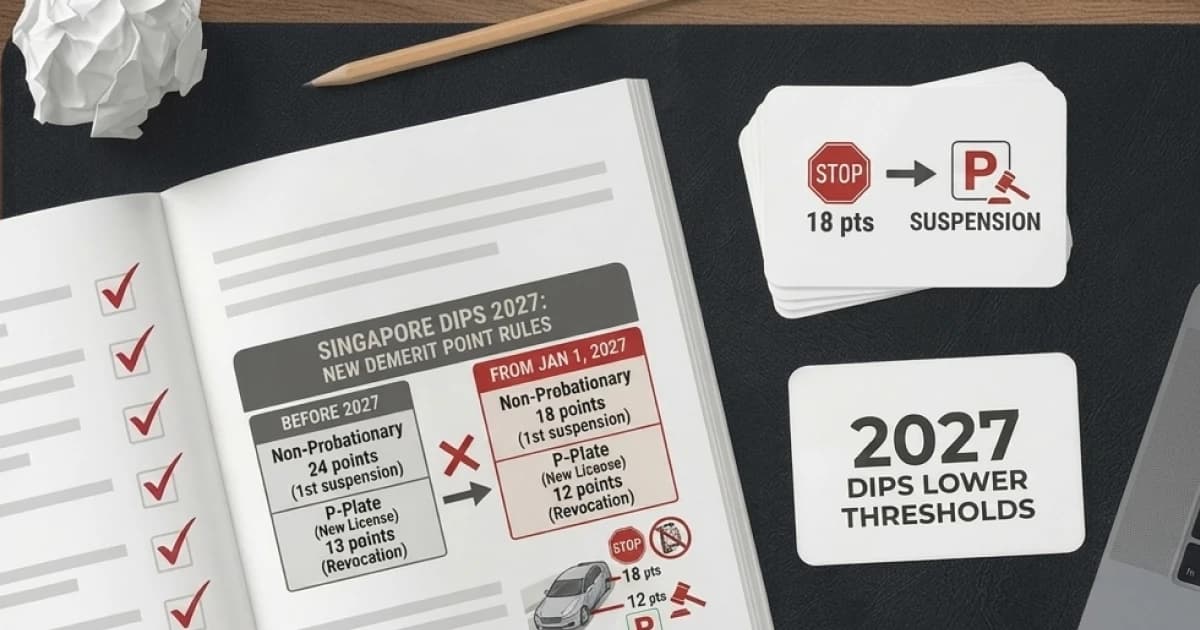
Singapore is tightening the Driver Improvement Points System (DIPS) from 1 January 2027. Announced by the Traffic Police, the revised regime lowers the demerit point thresholds for licence suspension and revocation, lengthens suspension periods, and removes lenient course deductions.
For learner drivers studying for the Basic Theory Test (BTT) or Final Theory Test (FTT), as well as new probationary (P-plate) drivers, these updates fundamentally alter the rules governing your driving licence.
1. Lower Demerit Point Thresholds
The point limits allowed before Traffic Police take enforcement action are dropping across both driver categories:
- Probationary (P-plate) drivers: The 12-month threshold drops from 13 points to 12 demerit points.
- All other drivers: The 24-month threshold is reduced from 24 points to 18 demerit points.
Under the 12-point limit, a P-plate driver who commits a single 12-point offence such as running a red light or holding a mobile phone while driving faces immediate licence revocation. Once revoked, the driving licence is cancelled entirely (including any and all classes), requiring the individual to re-apply, re-take, and pass the BTT, FTT, and practical driving test from scratch.
For experienced drivers, accumulating 18 points within two years (for instance, running a red light (12 points) while speeding (6 points)) results in an immediate suspension.
2. Longer Suspension Periods
Suspension durations will increase significantly across all tiers:
- 1st suspension: Increases from 12 weeks to 4 months.
- 2nd suspension: Increases from 24 weeks to 6 months.
- 3rd suspension: Set at 2 years.
- 4th and subsequent suspensions: Set at 5 years per instance.
Mandatory Re-testing
Any driver who receives a suspension of 1 year or longer automatically loses their driving licence. To drive again after serving the suspension, they must re-sit and pass all theory and practical driving tests.
3. Overhaul of Retraining Courses
The Traffic Police are also restructuring remedial options for suspended drivers:
- DIPS Retraining Course: Currently available for up to two suspensions, this voluntary 1½-day course will be restricted to first-time suspended drivers only from 2027. Completing the course reduces a first-time 4-month suspension down to 6 weeks.
- Safe Driving Course Discontinued: The 4.5-hour Safe Driving Course — which previously allowed non-suspended drivers to wipe off 4 demerit points — will be discontinued starting 2027 due to low historical participation. Eligible motorists offered this course in 2026 must complete it by 31 December 2026.
4. One-Time Transition Waiver on 31 December 2026
To ease the transition into the stricter rules, the Traffic Police will apply a one-off demerit point deduction on 31 December 2026 for existing offences committed before 2027:
- P-plate drivers: 1 demerit point waived.
- Experienced drivers: Up to 6 demerit points waived.
Unused waiver points cannot be saved, carried over into 2027, or applied to new offences committed in 2027.
Key Takeaways for Theory Test Candidates and New Drivers
- Update theory test answers: BTT and FTT question banks will reflect the 18-point threshold (experienced drivers) and 12-point threshold (P-plate drivers).
- Zero margin for error during probation: A single 12-point traffic offence during your P-plate year cancels your licence immediately.
- Clean record incentives remain: Accumulating zero demerit points for 12 consecutive months clears all existing points, while 3 consecutive clean years earns a Certificate of Merit (COM) for motor insurance discounts.
Prepare for your BTT and FTT using our up-to-date practice question bank to ensure you pass on your first attempt and keep your licence safe.