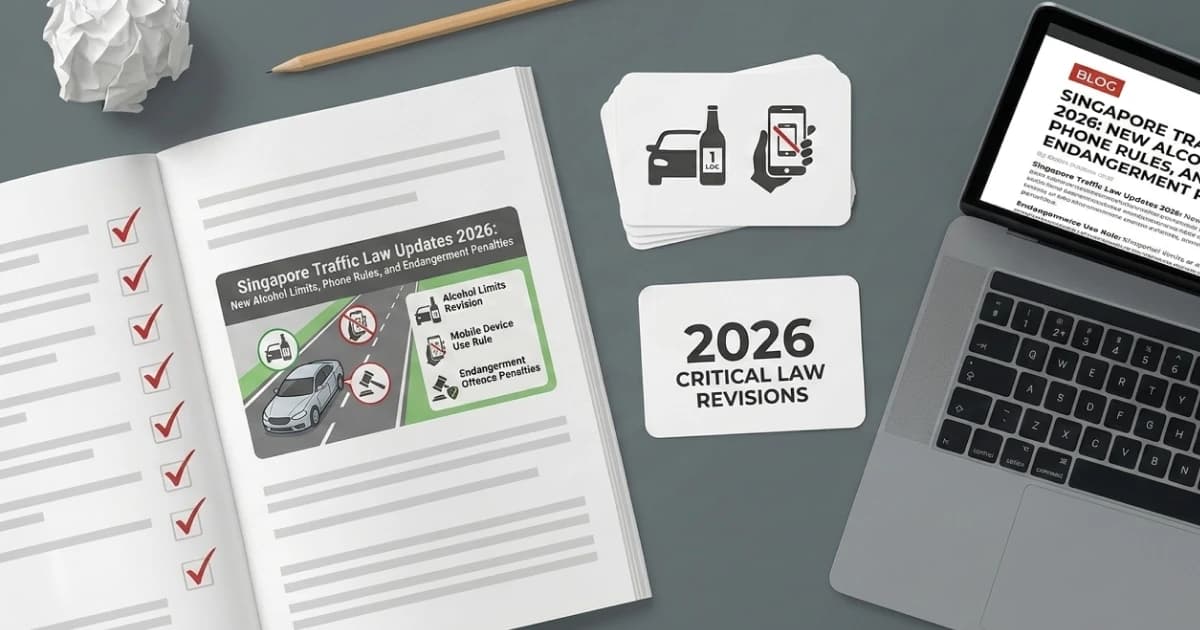
Singapore Parliament passed the Traffic (Miscellaneous Amendments) Bill on August 4, 2026. The new laws cut legal alcohol limits by more than half, create a zero-tolerance offence for drug driving, penalise holding a mobile phone while driving, and establish a new offence for purposeful endangerment.
For learner drivers studying for the Basic Theory Test (BTT) or Final Theory Test (FTT), these changes directly alter legal limits, penalty structures, and road rules tested in exam questions.
1. Alcohol Limits Cut by More Than Half
The statutory alcohol limits (in force since 1985) have been updated to match standards in Japan and South Korea:
- Breath alcohol limit: Reduced from 35 micrograms (mcg) per 100ml of breath to 15 mcg.
- Blood alcohol limit: Reduced from 80 milligrams (mg) per 100ml of blood to 30 mg.
First-time drink drivers face up to 12 months in prison, fines, and a minimum two-year driving ban. Prosecution guidelines will recommend mandatory jail time for first-time offenders who register very high alcohol levels, even without aggravating factors like crashes or injuries.
To streamline enforcement, Traffic Police will prosecute using readings from portable roadside breathalysers without needing to transport drivers to lock-up or seek doctor authorisation for blood tests.
Theory Test Impact
BTT questions testing prescribed alcohol limits will update to 15 mcg (breath) and 30 mg (blood). Any option listing 35 mcg or 80 mg will become incorrect once the law takes effect.
2. Holding a Phone While Driving Is Illegal
Under the revised law, police no longer need to prove you were calling, texting, or scrolling while driving. Physical holding of a mobile device while the vehicle is moving is sufficient for conviction.
- First offence: Fine $1,000 and up to six months in jail.
- Repeat offence: Fine $2,000 and up to one year in jail.
Enforcement will use traffic cameras and video evidence submitted by the public.
Drivers may use mounted phones for navigation, provided the mount does not obscure vision or compromise control. Touching or holding a device while stationary (such as at a red light) remains permitted, but holding it while rolling forward or moving in traffic violates the law.
Theory Test Impact
FTT questions on driver distraction will emphasize that physical custody of a device while moving constitutes an offence. For probationary (P-plate) drivers, demerit points paired with these fines make license revocation a real risk as P-plate drivers lose their license upon accumulating 12 demerit points within 12 months.
3. Purposeful Endangerment and Increased Crash Penalties
Parliament introduced a new offence of purposeful endangerment to target drivers who intentionally use vehicles to endanger lives:
- Penalties: Up to 15 years in prison, caning, fines, vehicle seizure, and driving disqualification for life (or a minimum of 10 years if special reasons apply).
Penalties for existing offences also increased:
- Dangerous driving causing grievous hurt: Maximum prison terms rise from 5 to 7 years for first offenders, and from 10 to 13 years for repeat offenders.
- Aggravating factors (e.g., drink driving): Additional prison terms increase by up to 18 months for first offenders (from 12 months) and up to 3 years 6 months for repeat offenders.
- Disqualification timing: Disqualification periods now commence only after an offender is released from prison, rather than running concurrently with prison sentences.
4. Strict Drug Driving Offence
A new drug driving offence allows prosecution if controlled drugs or psychoactive substances (such as etomidate) are detected in a driver's blood. Prosecutors do not need to prove a specific threshold or visible driving impairment. Drivers using legally prescribed medication are exempt if they had no reason to know the medication would impair driving.
Key Takeaways for Test Candidates
- Update memory work: Memorise the new limits: 15 mcg/100ml breath and 30 mg/100ml blood.
- Form good habits: Keep phones in mounts before starting the engine; do not pick up the phone while driving.
- Understand disqualification rules: Court-ordered driving bans execute after prison release, delaying any future re-test eligibility.
Start practicing for your BTT and FTT with our up-to-date question bank to master these new regulations before your exam.